
How to Spec a Cotton Bath Mat: GSM, Backing, Wash Cycles
Last updated: August 2026
Four numbers separate a cotton bath mat that survives a hotel laundry contract from one that doesn’t: GSM, backing type, wash-cycle rating, and absorbency. Buyers who put these four specs on the purchase order — rather than approving a mat on look and hand-feel alone — are the ones who don’t get a surprise on shipment three.
How Do GSM Bands Affect a Cotton Bath Mat’s Feel?
GSM (grams per square metre) tells you how dense the woven cotton is, and density is what a guest actually feels underfoot — not the pattern. Lighter bands dry faster and cost less to freight; heavier bands feel plush but take longer to dry between uses, which matters for high-turnover hotel bathrooms.
Cotton bath mats built as handwoven flatweave or braided cloth — the construction most cotton bath mats use, rather than a piled or tufted mat — sit in different weight categories depending on yarn count and picks per inch on the loom.
| GSM band | How it feels | Where it fits |
|---|---|---|
| 300-450 | Thin, quick-dry, moves easily on the floor | Budget retail, everyday home use, guest bathrooms with fast turnover |
| 500-700 | Substantial underfoot, absorbs a full foot-dry in one pass | Mid-tier hotel rooms, better retail home decor |
| 750-950+ | Dense, slow-dry, spa-weight | Boutique hotel bathrooms, premium retail where drying time isn’t a laundry-cycle constraint |
A quick look at the current bath mat range shows how these bands translate into finished product. A category manager stocking four colourways at 300 pieces each should specify the GSM band in writing, not just “heavy” or “plush” — those words mean different things to different weavers, and a 150 GSM swing between the approved sample and the shipped goods is common when the spec sheet leaves it to interpretation.
Where Do Cotton Bath Mats Belong — and Where They Don’t?
Cotton bath mats belong wherever there’s a hard floor next to standing water that gets mopped or laundered regularly: bathroom floors, shower exits, spa changing rooms, laundry rooms. They do not belong outdoors, at building entrances, or anywhere exposed to rain, since untreated cotton has no weatherproofing and will mildew or rot through repeated wetting-drying cycles outside.
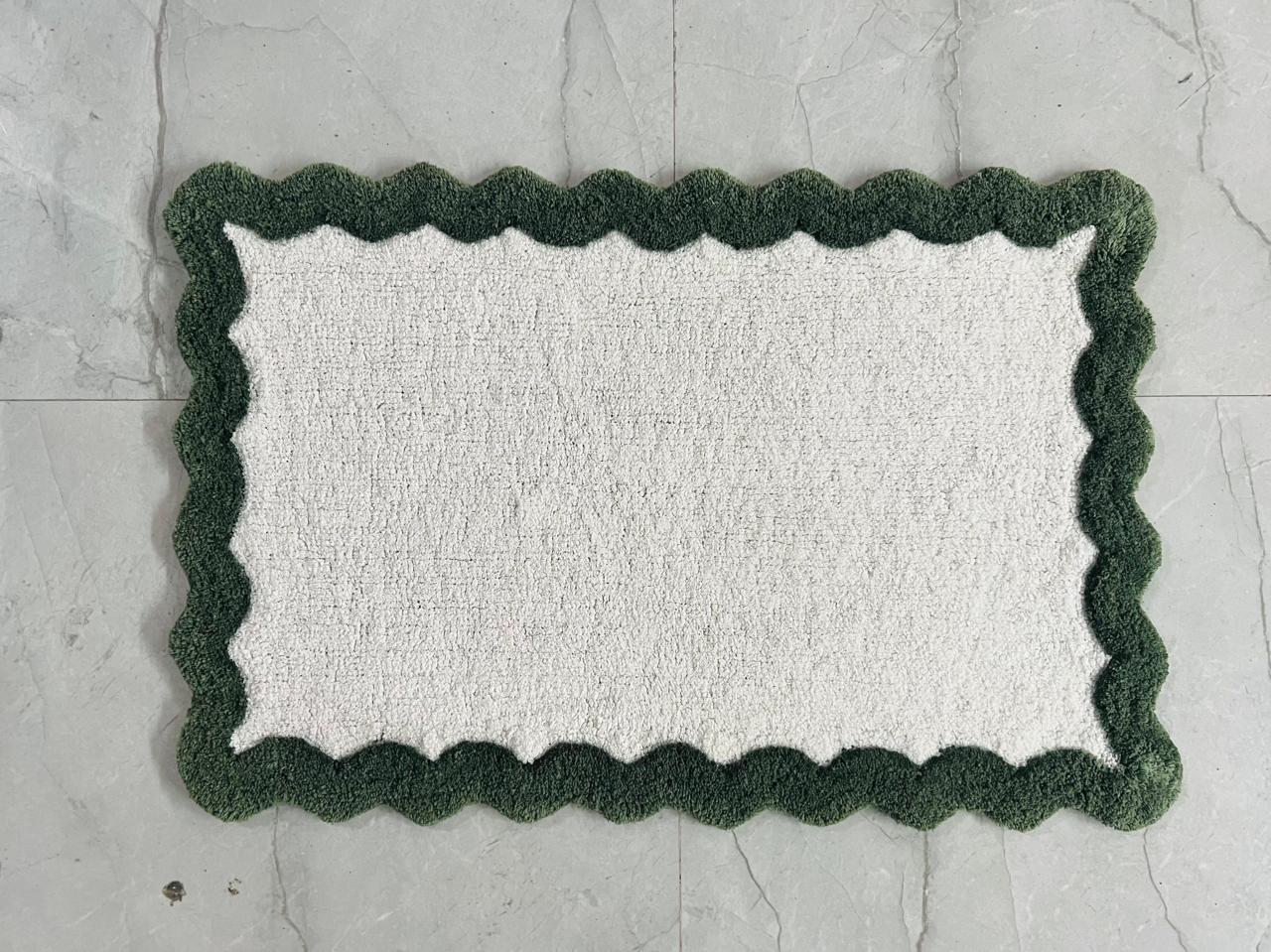
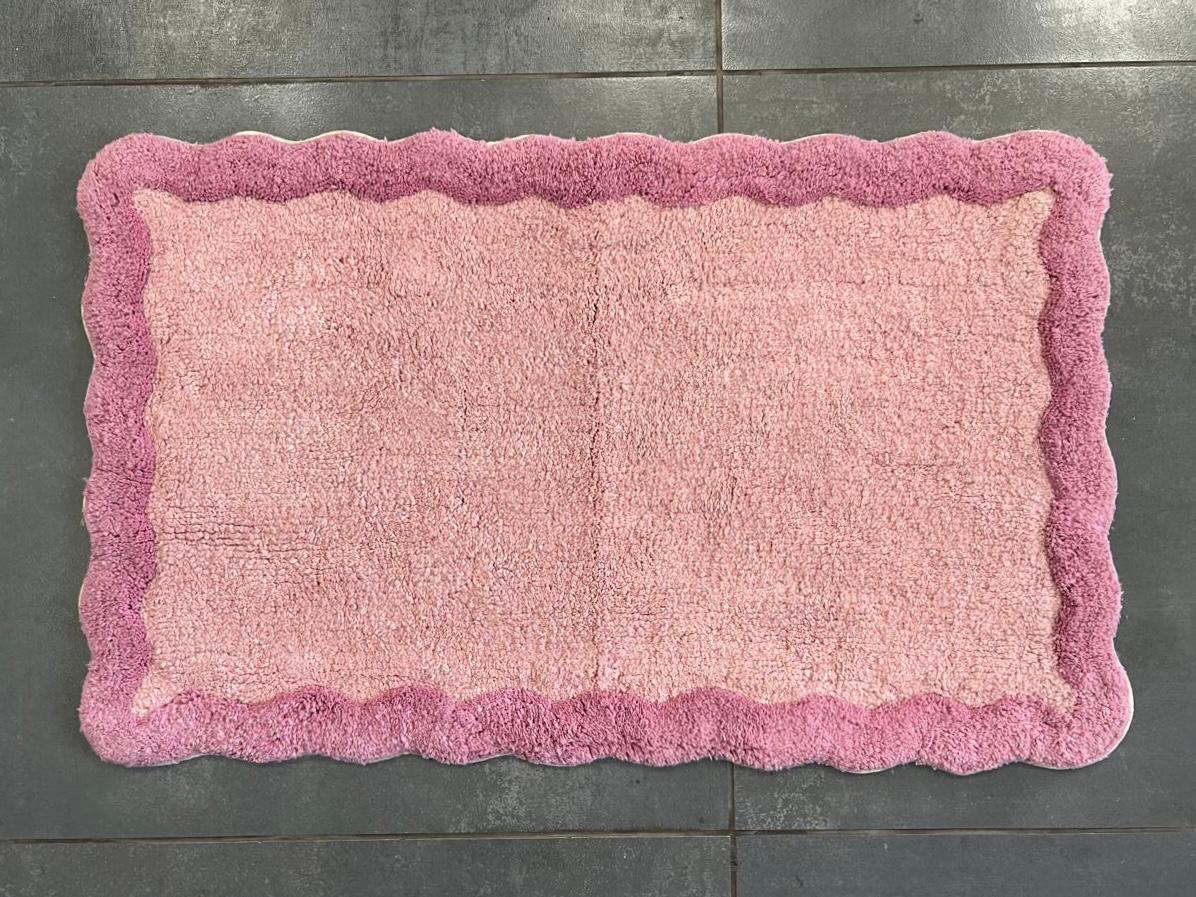
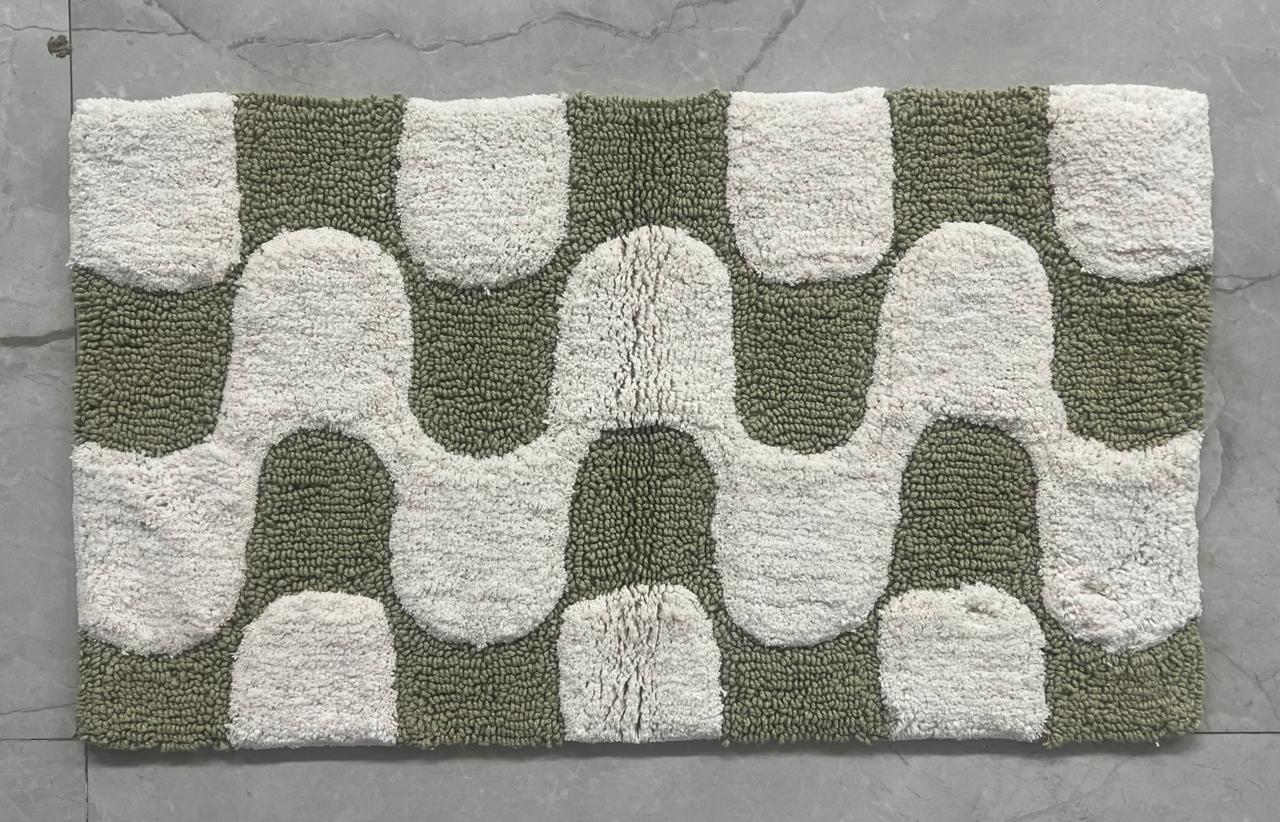
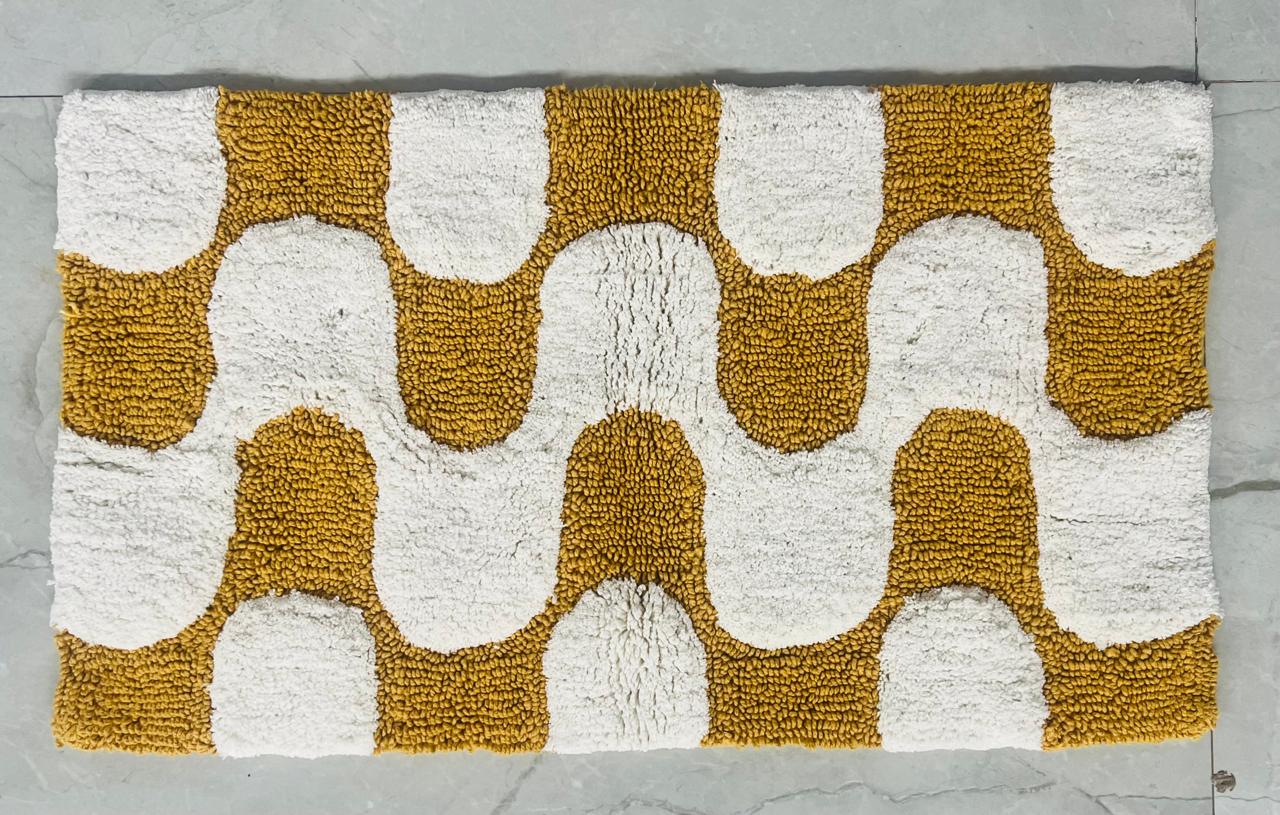
This is a genuine limitation, not a marketing caveat. A handwoven or braided cotton mat is washable, which is exactly what makes it right for a bathroom and wrong for a porch. Printed cotton bath mats — a plain handwoven cotton ground with a pattern block- or screen-printed onto the finished cloth, which is how ranges like the scallop and arch motifs shown here are built — are a retail-floor product, not an outdoor doormat, and should never be quoted against an entrance-mat brief. If a buyer needs something at a front door or on a covered patio, that’s a different fibre and a different construction entirely; cotton’s job is the room where the towel lives, nothing further.
What Backing Options Keep a Bath Mat Safe on Wet Tile?
A cotton bath mat needs a slip-resistant backing wherever it sits on smooth tile or stone, because a flatweave or braided cotton back alone has almost no grip against a wet, polished surface. The three common options are a full latex coating, a dot-pattern PVC lamination, or no backing at all for use over a separate bath rug pad.
Full latex backing gives the most consistent grip and is what most hotel procurement specs default to, since it survives repeated commercial laundering better than a printed dot pattern, which can crack and flake off after enough hot-water cycles. A dot backing is lighter and cheaper, and works fine for retail SKUs sold to households doing their own laundry on a gentler cycle. No backing at all is only appropriate when the mat sits over carpet, underlay, or a rubber pad supplied separately — never loose on tile in a guest bathroom, which is a liability question as much as a comfort one.
Ask a supplier for the backing’s wash-cycle rating separately from the face fabric’s rating. It’s common for a mat to pass 40 cycles on colour and shrinkage but have the backing start delaminating at cycle 20 — two different failure points that a single ‘machine washable’ claim on a spec sheet can hide. Buyers comparing reversible bath mat constructions should ask this question twice, since a reversible face doubles the number of surfaces that need a wash-cycle rating.
How Is Wash-Cycle Durability Actually Tested?
Wash-cycle testing means running a bath mat through repeated laundering cycles and checking GSM, colour, and backing adhesion at set intervals, typically 10, 20, and 30 cycles. A mat that loses more than 5-8% of its starting GSM by cycle 20 is shedding fibre faster than a hotel laundry contract can absorb.
For hotel-bound orders we run cotton bath mats through a 30-cycle wash protocol before a spec sheet is locked, checking shrinkage against the ISO 6330 home-laundering procedure at each stage — a mat that shrinks past the tolerance on the PO by cycle 15 gets rejected before it reaches a container. Across export orders shipped through 2025, the reorder complaints we tracked came almost entirely from colour bleed rather than shrinkage — a sign the original buyer had specified GSM and size but never asked for a colourfastness rating tied to a cycle count.
The mistake that costs money: specifying GSM alone and skipping the wash-cycle count entirely. A mat can hit 600 GSM fresh off the loom and drop to 550 GSM by the third commercial wash if the yarn twist is loose — the shipment ‘feels lighter,’ the retail buyer assumes a factory substitution, and it’s actually a testing gap in the original spec.
Hotel vs Retail: Which Specs Actually Differ?
Hotel procurement and retail buying share the same four specs but weight them differently: hotels prioritise wash-cycle survival and backing safety because the mat gets laundered industrially hundreds of times a year, while retail prioritises pattern range and per-carton cost because a household mat gets washed at home on a far gentler cycle.
| Spec | Hotel priority | Retail priority |
|---|---|---|
| GSM | Mid-to-heavy band that survives industrial dryers without matting | Whatever hits the price point; lighter bands common |
| Backing | Full latex, rated for 200+ commercial wash cycles, non-negotiable | Dot backing acceptable; some SKUs sell without any backing |
| Wash testing | Colourfastness and shrinkage data requested at PO stage | Often trusted to the supplier’s standard QC, not independently tested |
| Design range | Fewer, more consistent colourways for a property-wide reorder | Wide print and pattern range, seasonal colour drops |
A hotel group ordering for 40 properties will ask for the same backing across every colourway because housekeeping doesn’t want a different washing rule per SKU. A retail chain buying for four regions is usually fine mixing backing types across a print collection like the one shown here, as long as each SKU’s care label matches what’s actually laminated to the back. Buyers moving between the two worlds — a hospitality group opening a retail line, for instance — should read a bathmat sourcing guide for buyers before assuming one spec sheet covers both channels.
Building the Spec Sheet
None of these four specs work in isolation — a heavy GSM with the wrong backing still fails on a hotel floor, and a well-backed mat that was never wash-tested is a gamble on the second order. Buyers comparing chenille bath mats against a printed cotton range should ask every shortlisted supplier for the same four numbers, in writing, before a sample ships — not after.
Printed and handwoven cotton ranges, and custom bulk bath mat programs, all get evaluated against this same spec sheet, whichever construction ends up in the container. If you’re scoping a bath linen program for Q4, send over your current spec sheet and we’ll flag where the gaps usually sit before you get to sampling.
Frequently Asked Questions
What GSM should I specify for hotel bath mats?
Most hotel procurement specs land between 500-700 GSM, which absorbs a full foot-dry in one pass without the slow drying time of spa-weight mats above 750 GSM. Always pair the GSM number with a wash-cycle rating in the same spec line — GSM alone doesn’t tell you if the mat holds that weight after 20 commercial washes.
What is the MOQ for custom cotton bath mats?
MOQs for custom cotton bath mats typically start around 300-500 pieces per colourway for handwoven or printed ranges, though this varies by pattern complexity and backing type. Multi-colourway hotel orders can consolidate MOQ across SKUs if the GSM and backing stay consistent.
How long does sampling take for a custom printed cotton bath mat?
Sampling for a custom screen- or block-printed cotton bath mat usually runs 10-14 days from approved artwork, plus additional time if the buyer requests a wash-cycle test result before sign-off. Skipping that test to save a few days is where reorder mismatches usually start.
Can cotton bath mats be customized with private label packaging?
Yes — private label packaging, woven or printed logo tags, and custom colourways are standard on bulk cotton bath mat orders. The backing and GSM spec should be locked before artwork goes to print, since a late backing change can shift drying time and pattern registration.
Are cotton bath mats safe on tile floors without a backing?
No — an unbacked flatweave or braided cotton mat has very little grip on wet tile or stone and should not be placed loose on a hard bathroom floor. It needs either a laminated latex or PVC-dot backing, or a separate non-slip pad underneath, before it goes into a hotel or retail bathroom.
Enquire about your collection or project
Tell us which products you need, your preferred sizes, quantities and destination. You can also share your collection or project requirements.
Make it part of your
next collection.
Share the designs you like, approximate quantities and destination. Let’s discuss samples, pricing and custom options.
