
Rug Sourcing From India: The Insider Buyer Roadmap
Last updated: August 2026
Rug sourcing from India offers real cost and craft advantages in handmade wool, jute, and cotton floor coverings, but buyers routinely lose weeks — and margin — navigating supplier vetting, sampling timelines, and quality variance. This guide breaks the sourcing process into the checkpoints experienced importers actually use, from first sample to final container.
Why India Remains the Global Leader in Handmade Rug Production and Export Volumes
India leads global handmade rug and carpet exports because it is one of the few countries with the full production chain — wool and cotton spinning, natural dyeing, hand-knotting and power-loom weaving, and finishing — concentrated within reach of major ports, backed by a multi-generational weaver workforce that newer exporting countries haven’t replicated at scale.
That breadth means a single sourcing region can supply hand-knotted wool for a hospitality program and flat-woven jute for a retail chain’s spring set without switching countries or renegotiating quality expectations. But scale alone isn’t a quality guarantee, which is why serious buyers now check how Indian production standards compare against global benchmarks before treating volume capacity as a proxy for consistency.
Across export orders we shipped in 2025, close to 70% of first-time overseas buyers requested a pre-shipment inspection before releasing final payment — up from under half in 2022. Quality verification has become the norm, not the exception, even from established production hubs.
Understanding India’s Rug-Weaving Cluster Advantage: Traditions, Material Access, and Export Infrastructure
India’s rug-weaving strength comes from geographic clustering — spinning mills, dye houses, loom units, and finishing and packing facilities operating within short trucking distance of each other. That proximity shortens the path from raw yarn to export-ready roll compared with sourcing from a single, isolated factory.
Our weaving units operate inside one such corridor in northern India, where wool scouring, jute spinning, and cotton warping happen within a few hours’ drive of the loom sheds that turn raw fiber into finished rugs. Hand-knotting skill is passed down through weaver families rather than taught in a training center, which is part of why knot density and pattern precision hold up across large production runs in ways newer weaving regions still struggle to match. Power-loom jacquard capacity has grown alongside the traditional hand-knotting base, giving buyers a volume option without moving to a different supplier network.
Where Indian Handmade Rugs Perform Best — and Where They Don’t
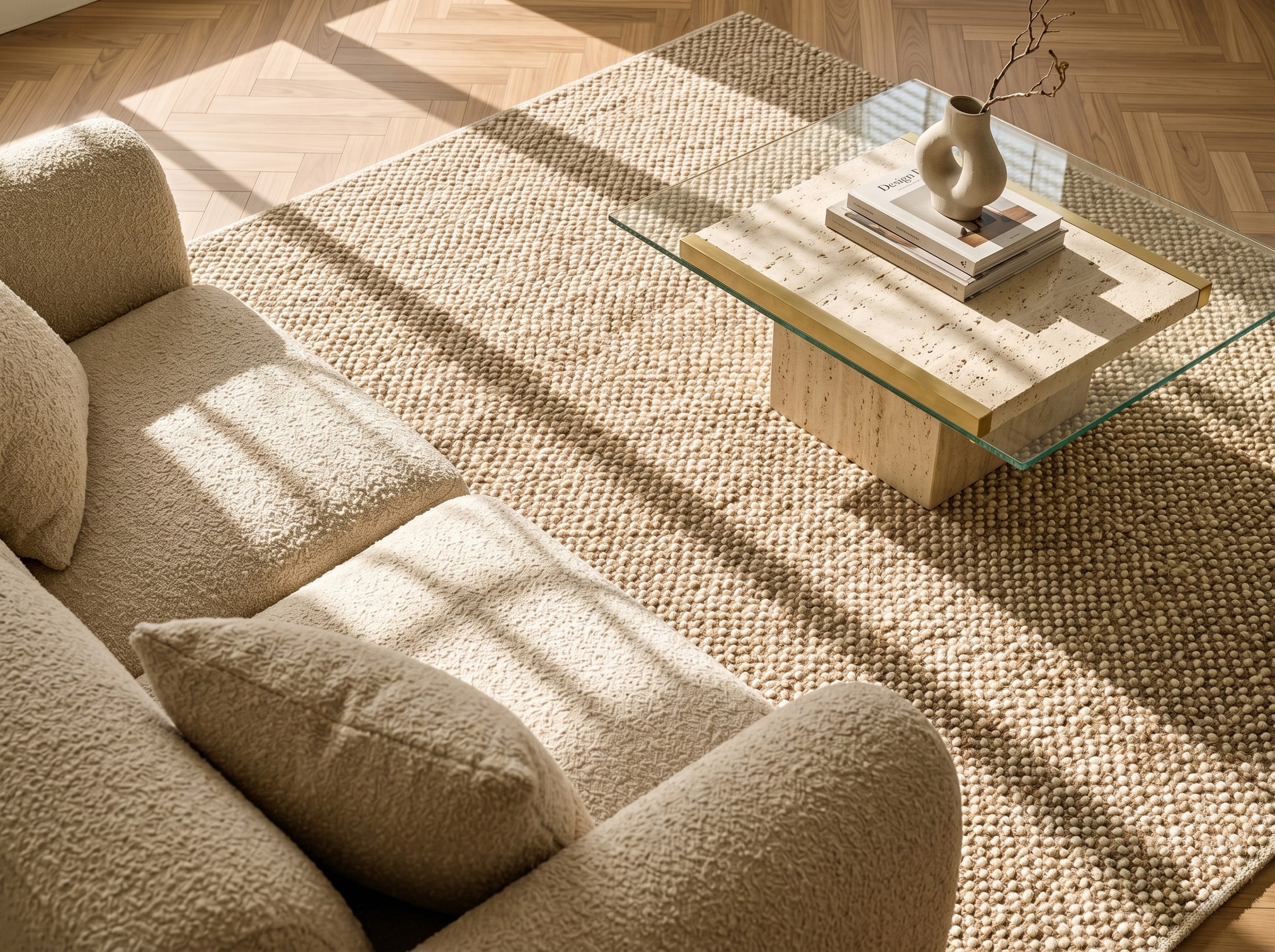
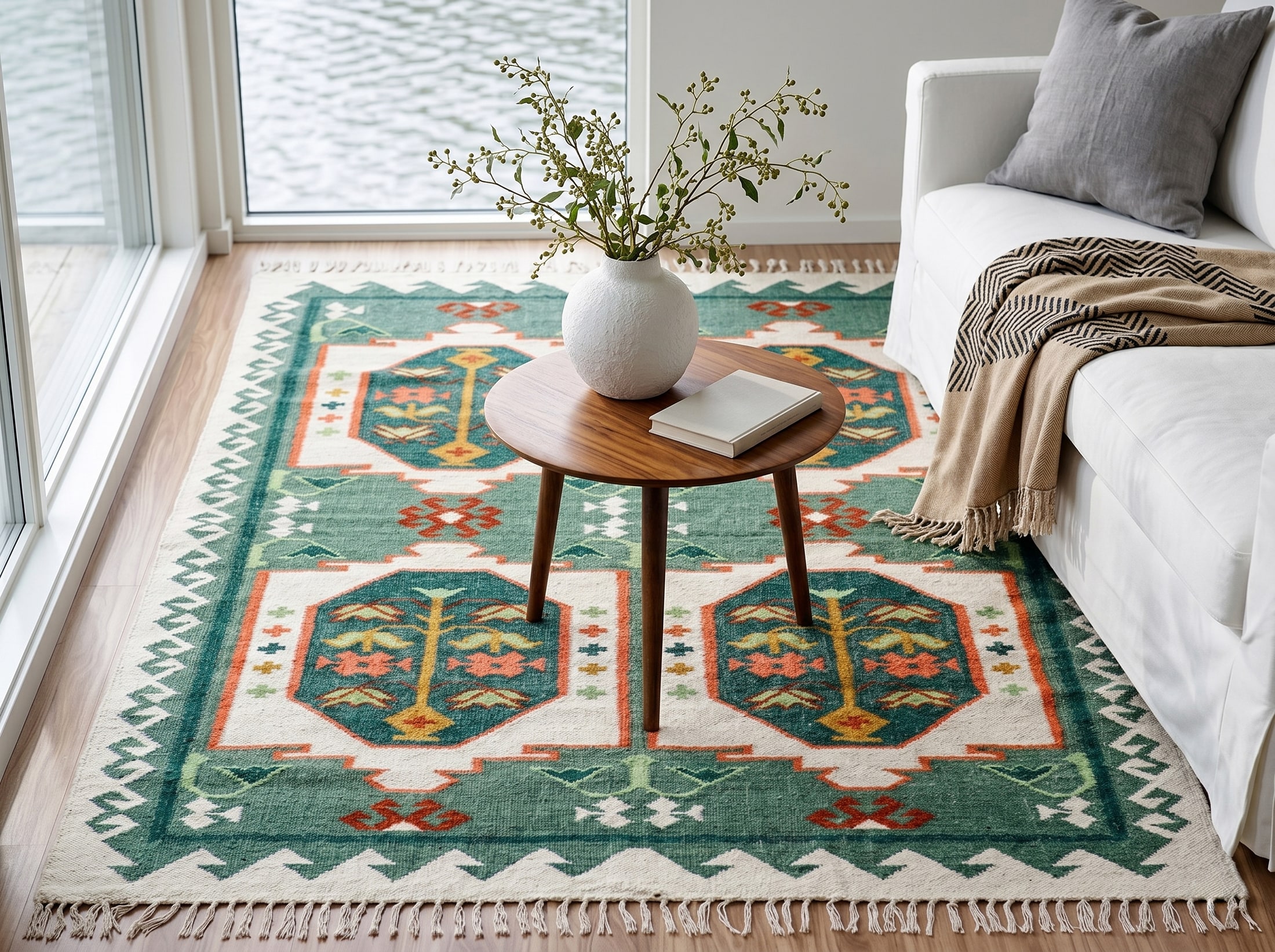
Hand-knotted wool and flat-woven jute or cotton rugs are built for dry, low-moisture interiors — living rooms, bedrooms, hotel suites, and dining areas — where foot traffic is moderate and cleaning stays dry. They are not built for bathrooms, entryways, or outdoor spaces where standing water or hose-down cleaning is routine.
| Construction | Best Setting | Moisture Tolerance | Cleaning Method | |—|—|—|—| | Hand-knotted wool | Living rooms, bedrooms, hotel suites | Low — spot clean only | Dry vacuum, professional wash | | Flat-woven jute/cotton | Living rooms, closets, low-humidity zones | Very low — avoid wet mopping | Shake out, dry vacuum | | Power-loom wool-blend | Hallways, corridors, retail floors | Low to moderate | Vacuum, occasional dry shampoo | | Kilim/dhurrie flatweave | Layered looks, dining areas | Low | Dry clean, light spot clean |
Jute belongs in the bedroom, not the bath. For wet zones, buyers need bath mats built specifically for repeated water exposure, not a woven floor rug pressed into service because it happened to be in stock. Specifying the wrong construction for a wet-zone SKU is one of the more expensive mistakes a category manager can make, since the returns show up months after the order shipped.
The End-to-End Sourcing Process: Sampling Timelines, MOQs, Quality Checkpoints, and Shipping Logistics
A typical handmade rug sourcing cycle runs: inquiry and spec sheet, sampling, MOQ negotiation, bulk weaving, pre-shipment inspection, and ocean freight. Sampling generally takes 8-14 days depending on construction, MOQs commonly run 300-1,000 pieces per design for wholesale programs, bulk weaving takes 6-10 weeks, and ocean freight to US or European ports adds another 4-6 weeks.
In our 2026 sampling data, hand-tufted wool designs move from approved artwork to ex-factory sample in 12-14 days on average, while flat-woven jute or cotton samples typically clear in 8-10 days — the difference comes down to dye-lot matching and finishing steps, not loom speed. A category manager ordering 300 pieces across four colorways will typically see a combined sampling-and-bulk lead time of 10-12 weeks before the container books space, longer if any colorway fails second-round approval and needs re-dyeing.
Buyers running their first program should map this against their own retail calendar; a full walkthrough of the rug import process from inquiry to delivery is worth reviewing before locking a purchase order date. Once bulk production clears inspection, the logistics of moving container-load rug orders — booking, documentation, and transit windows — becomes the next bottleneck to plan around.
Navigating Certifications, Customs, and Compliance for US, EU, and UK Imports
Buyers importing handmade rugs into the US, EU, or UK should request child-labor and social compliance certification (such as GoodWeave), REACH-compliant dye documentation for EU shipments, CPSIA flammability test reports for US retail, and correctly classified HS codes in the 5702-5703 range to avoid customs holds.
Missing paperwork is a far more common delay than a quality failure. A complete document set typically includes the commercial invoice, packing list, certificate of origin, and lab test reports matched to the destination market’s requirements — EU dye compliance documentation doesn’t automatically satisfy a US CPSIA request, and customs brokers will flag the mismatch rather than assume it’s covered. Buyers new to importing floor coverings should confirm which certificates their broker actually needs before production starts, not after the container is booked.
How to Evaluate Indian Rug Suppliers: Factory Audits, Weaver Relationships, and Quality Consistency Markers
Vetting an Indian rug supplier means checking three things beyond price: a recent third-party factory audit report, whether weavers are direct employees or subcontracted through unaudited home looms, and documented tolerance ranges for pile height, color, and knot density across production runs.
Specify colorfastness only as a numeric grade without naming the test method — ISO 105 versus AATCC — and the second shipment can land half a shade off simply because the lab used a different standard. We log pile-height and knot-density variance on every production run and share that report with buyers ahead of shipment, which is the kind of documentation worth asking any supplier for, not just the ones offering to send it. Reviewing how to find and confirm factory-direct rug suppliers rather than trading houses is a useful next step before committing to a first bulk order.
Common Sourcing Pitfalls and How Experienced Exporters Help Buyers Avoid Them
The costliest mistakes in rug sourcing from India are rarely about the product itself — they’re about timing and documentation: skipping pre-shipment inspection, approving a colorway verbally instead of in writing, and underestimating how far ahead of peak shipping season a purchase order needs to land.
- Skipping inspection to save time: a single missed dye-lot variance can mean re-sorting an entire shipment at the destination warehouse.
- Verbal colorway approval: without a signed lab dip or physical strike-off on file, disputes over “close enough” color have no resolution.
- Underestimating peak season: loom capacity tightens ahead of major Western retail seasons, and a PO placed too late simply queues behind buyers who booked earlier.
Experienced exporters flag these risks before they become delays, which is largely why long-term buyer-supplier relationships tend to outperform one-off transactional orders on both price stability and lead-time reliability over multiple seasons.
If you’re mapping a sourcing calendar for next year’s collection, sharing a rough spec sheet — construction, sizes, target colorways — gets you a realistic sampling and shipping timeline back within a few days, not a generic quote.
Frequently Asked Questions
What is the minimum order quantity (MOQ) for handmade rugs from India?
MOQs vary by construction and typically run 300-1,000 pieces per design for wholesale programs, split across sizes and colorways. Hand-knotted constructions often carry higher MOQs than power-loom or flat-woven designs because setup and dye-lot planning don’t scale down efficiently below a certain volume.
How long does sampling take for custom rugs sourced from India?
Sampling generally takes 8-14 days from approved artwork, depending on construction. Flat-woven jute or cotton samples typically clear in 8-10 days, while hand-tufted or hand-knotted wool designs run 12-14 days due to additional dye-matching and finishing steps.
How do I verify a rug supplier in India is reliable before placing a bulk order?
Request a recent third-party factory audit report, ask whether production runs through direct weavers or subcontracted home looms, and get documented tolerance ranges for color, pile height, and knot density. A supplier that shares this data before you ask is usually one worth ordering from.
What certifications should I request when importing rugs from India to the US or EU?
Ask for social compliance certification such as GoodWeave, REACH-compliant dye documentation for EU shipments, CPSIA flammability reports for US retail, and confirm the HS code falls correctly within the 5702-5703 range to avoid customs delays.
Can Indian rug manufacturers produce custom sizes and private label packaging?
Yes, most established exporters offer custom sizing, colorway development, and private label packaging, though these typically extend sampling timelines by a few days and may raise MOQs slightly. Sheeltex handles custom sizing on both hand-knotted and power-loom programs alongside standard catalog sizes.
Enquire about your collection or project
Tell us which products you need, your preferred sizes, quantities and destination. You can also share your collection or project requirements.
Make it part of your
next collection.
Share the designs you like, approximate quantities and destination. Let’s discuss samples, pricing and custom options.
