
Braided Rug Manufacturing: How to Spot a Well-Made Braid
Last updated: September 2026
A three-strand braid and a five-strand braid can look nearly identical in a listing photo, but pull on the coil and the difference shows immediately: one holds its shape, the other loosens at the first tug. That gap between what a braided rug looks like and how it actually performs is where most wholesale buyers get burned on their first import order.
The history and craft of hand-braided rugs — from rag rugs to premium jute blends
Braided rugs started as a way to use up fabric that would otherwise be thrown away: cotton rag strips cut from worn sheets and clothing, wound into a rope, then coiled flat and stitched into a mat. That same coiling logic later moved onto jute, giving the fiber a construction beyond flatweave and panja that could take heavier foot traffic without a woven backing to hold it together.
Jute braids carry jute’s usual dye character: colour goes on and comes out a step duskier and warmer than the shade card suggests, so a mustard yarn reads more amber once it’s braided and dried. That’s a fact of the fiber, not a flaw in the run, and it’s worth flagging to any buyer approving colourways off a screen rather than a swatch. Cotton rag rugs sit on the other end of that spectrum: true-to-shade colour, a washable handle, and a genuine recycled-material story that works on a swing tag. Roughly one in four braided rug orders we shipped in 2025 specified recycled or deadstock cotton strips as the raw material, up from a smaller share the year before, which tells you where retail buyers are putting their sustainability budget.
The construction detail that matters more than fiber choice, though, is what happens at the braiding stage itself.
Step-by-step overview of the braiding process and how it affects durability
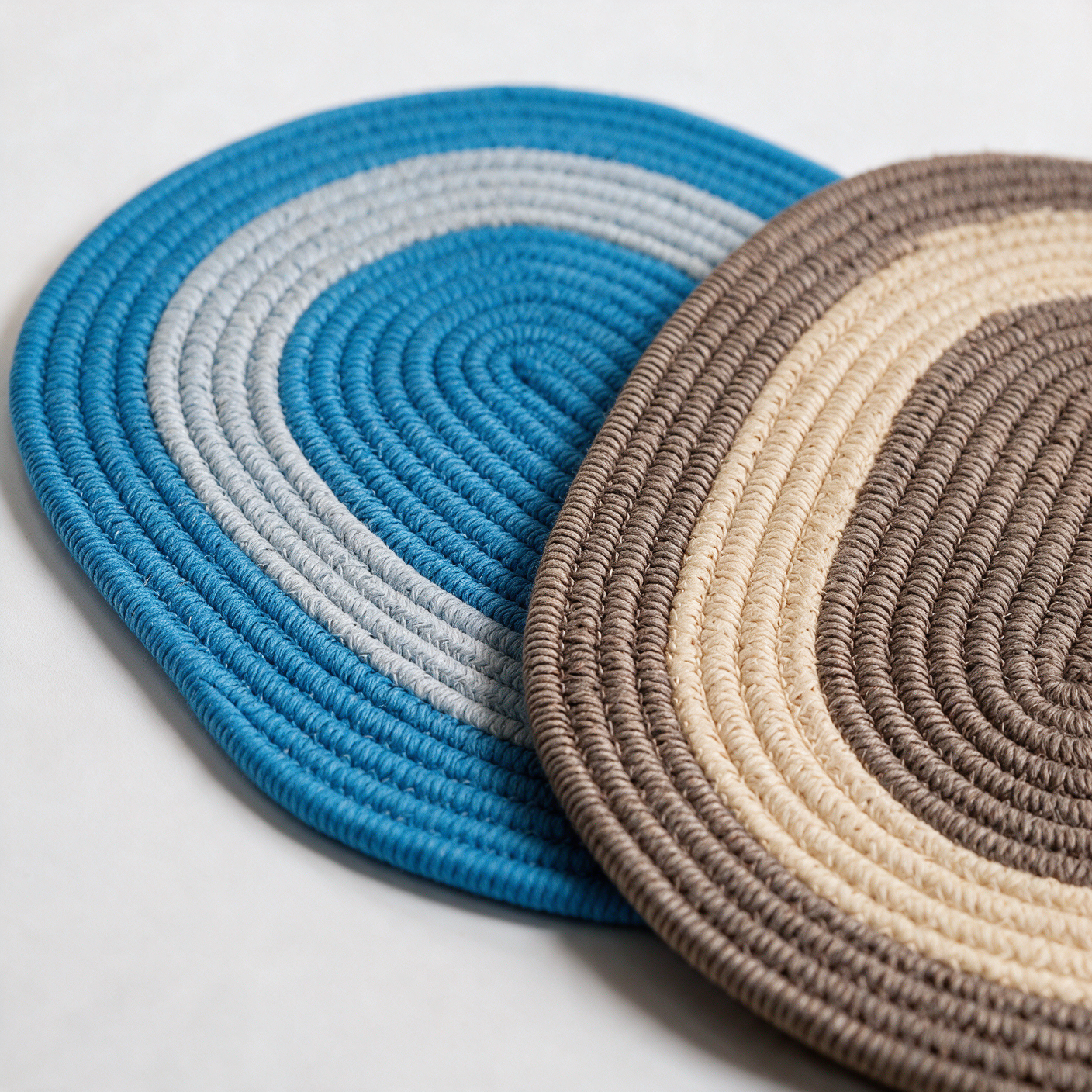
Hand braiding runs three stages: strand preparation, braiding the strands into a continuous rope, and coiling that rope into rounds locked together with a stitch. Durability is decided at the second stage. Loose wind tension produces a braid that looks full on day one and flattens within a season; tight, even tension holds its profile for years under the same traffic.
Strand preparation sets the ceiling for everything after it. Jute and cotton strips need consistent width, cut on grain, or the finished braid bulges in patches. Once strands are ready, our weaving units in northern India braid by hand, coil by coil, feeding tension by touch rather than machine — which is exactly why strand-count consistency has to be checked on arrival rather than assumed from the spec sheet.
The stitch that joins each coil to the next is the single most common failure point in cheap imports. A proper lock-stitch (sometimes called a lacing stitch) runs through both adjoining coils at regular intervals; a glued or loosely tacked seam looks fine folded in a carton and separates within weeks of foot traffic.
| Strand count | Look | Typical use |
|---|---|---|
| 3-strand | Classic rope pattern, flatter profile | Entryways, budget-tier programs |
| 5-strand+ (chunky) | Thicker, more textured, higher pile-like feel | Statement pieces, hospitality lobbies |
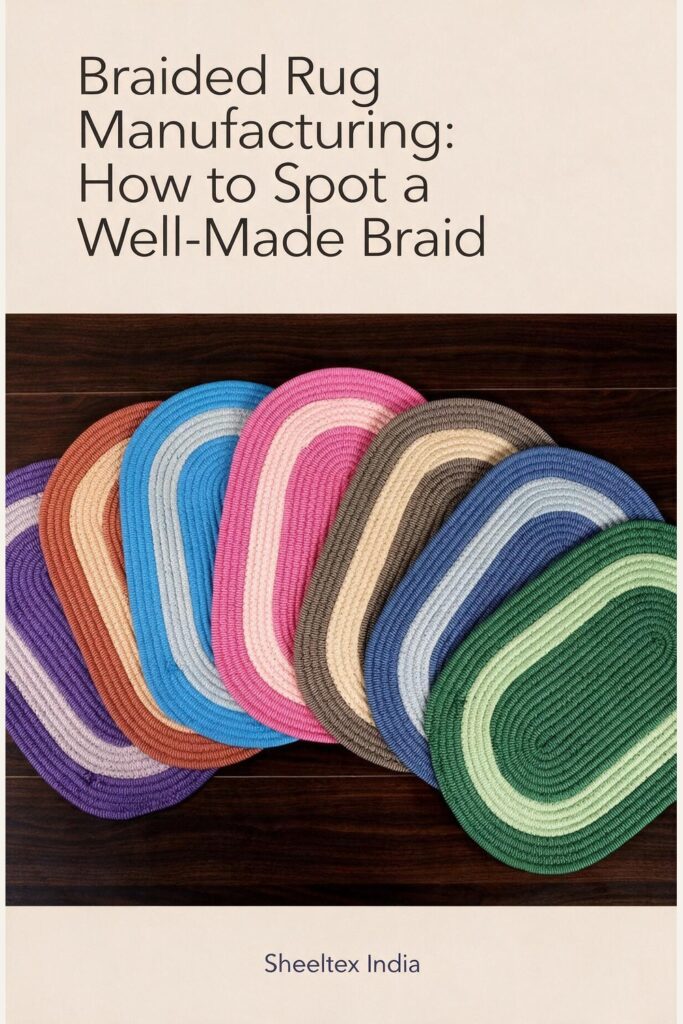
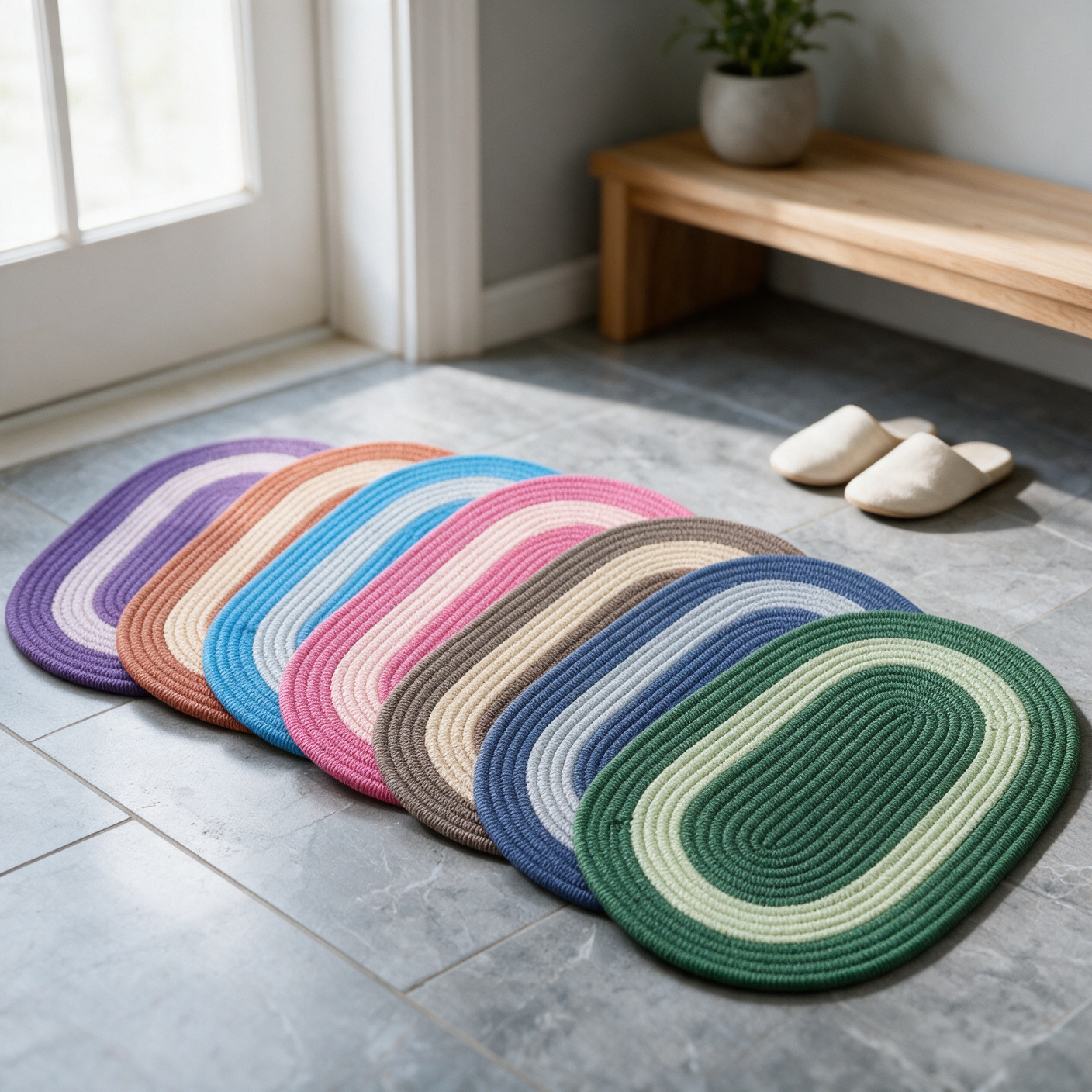
Profile MTA-26001 ‘Colourful Braided Mats’ — a PP option for outdoor and budget programs
MTA-26001 is built from PP (polypropylene) tape yarn rather than jute or cotton, which puts it in a different category entirely: it tolerates surface moisture and a quick wipe-down that a natural-fiber braid cannot, at a cost point suited to high-volume entryway and assorted-mat programs rather than premium natural-fiber ranges. It ships in the Ready Stock / Assorted line, sample size 40x60cm, against a 500-piece MOQ.
That distinction matters because the four materials in a typical braided-rug catalogue behave very differently once they leave the warehouse:
| Material | Construction | Best placement | Moisture handling | Dye behaviour |
|---|---|---|---|---|
| Jute | Handwoven flatweave, panja, or braided | Dry indoor rooms only | Holds moisture — never bathrooms or outdoor | Dyes down, warmer and duskier than the digital shade |
| Cotton / recycled cotton | Handwoven flatweave or braided | Bath mats, throws, kids’ rugs, everyday use | Washable indoors; not outdoor-rated untreated | True to shade |
| Recycled PET yarn | Woven or tufted | Contract and hospitality high-traffic zones | Wipeable, colourfast | Dyes brighter and more saturated |
| PP (MTA-26001) | Braided | Covered entryways, mudrooms, budget retail programs | Moisture-tolerant, easy wipe-down | Synthetic, colourfast |
PP is not a substitute for a fully weatherproof spec. For uncovered patios, poolside decks, or genuinely wet-weather use, PVC constructions built for outdoor exposure are the correct answer, and jute belongs nowhere near either setting. What MTA-26001 does well is sit between the two: an entryway or mudroom mat that shrugs off tracked-in moisture and a light mop, at a price that supports assorted colourway programs without the natural-fiber premium.
How to test braid tightness and seam strength before ordering wholesale
Pinch a coil between thumb and forefinger and try to slide the strands apart: a well-braided rope shouldn’t shift more than 1-2mm. Then tug the lock-stitch between two coils with firm hand pressure — it should hold. Either test failing on a pre-shipment sample is a reliable predictor of complaints after six months in a retail setting.
A category manager ordering 500 pieces across six colourways should build these checks into the pre-shipment inspection, not leave them to a visual scan:
- Strand slide test — pinch and pull; 1-2mm of give is normal, more means loose winding.
- Lock-stitch pull test — tug the seam between coils; a popped stitch here means separation in transit.
- Edge check — the outer edge should be folded and stitched, never glued flat.
- Colourfastness rub — a dry and wet cloth rubbed against the surface should not transfer dye.
- Flex test (PP only) — fold the mat sharply and check for cracking at the fold; this isn’t a failure mode for jute or cotton braids, so save it for synthetic yarn.
We run a 20-fold flex test on PP braided mats before approving a production run; jute and cotton constructions get the dry-and-wet crock rub instead, since flex-cracking simply isn’t how those fibers fail. The same logic around wind tension and stitch integrity is why jute holds up so well in high-traffic commercial spaces when it’s braided correctly, and why the identical-looking rug from a different production run doesn’t.
Trend note: chunky braids are back — why retailers are stocking them now
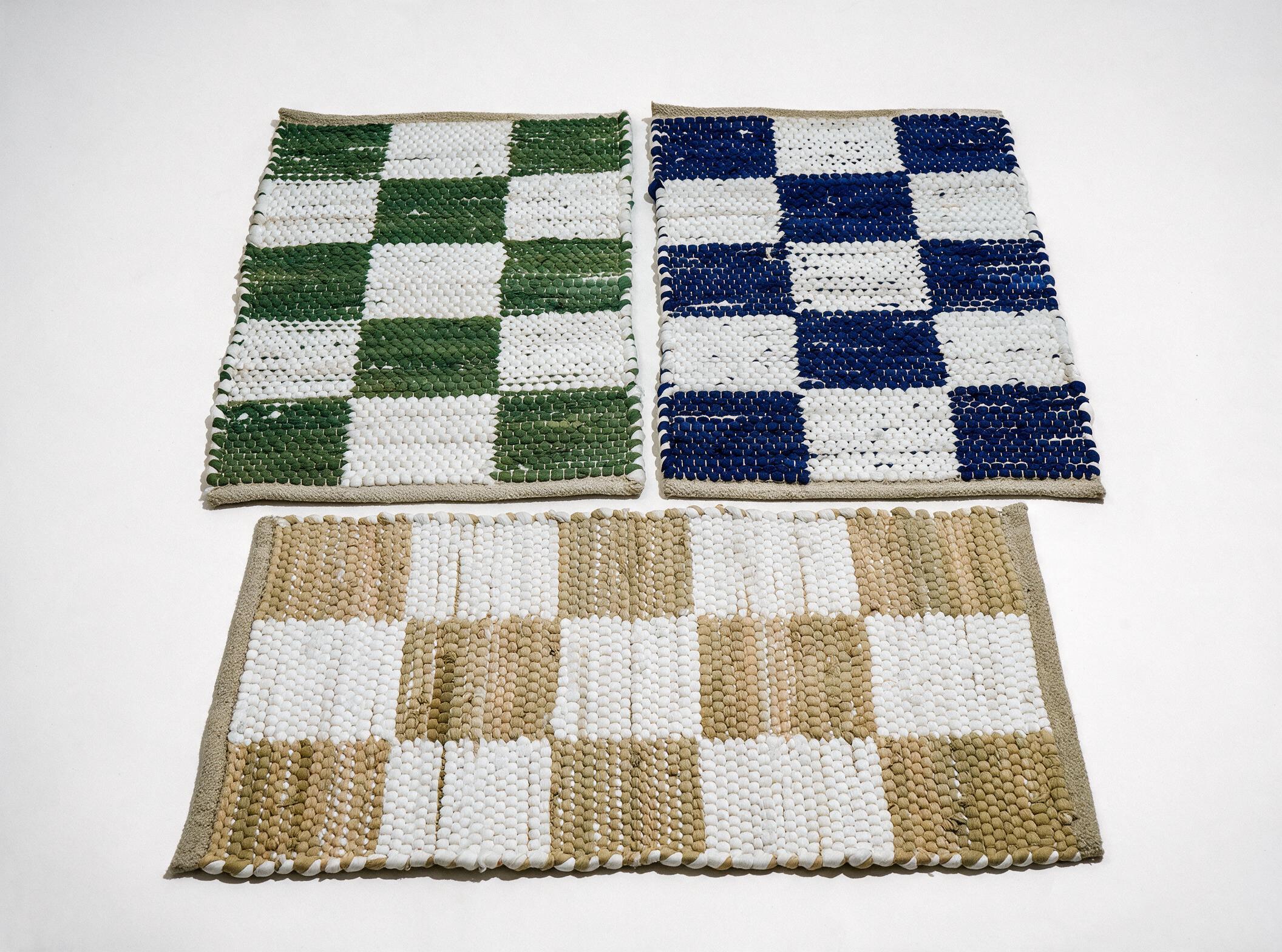
Wide-strand, five-plus braids are reappearing across 2026 retail buys because they read as a tactile, oversized-natural-look statement in a season favouring exactly that, and because a thicker strand hides minor tension inconsistencies better than a fine three-strand braid does. That second point is a manufacturing convenience as much as a design trend, and it’s worth knowing which one is driving a given supplier’s push toward chunky constructions.
Order data from 2026 assorted mats programs shows chunky-braid SKUs outselling fine three-strand SKUs by close to two to one on reorders placed by European home-goods retailers this year. Recycled cotton rag constructions are riding the same wave particularly hard, since a chunky braid amplifies the visible texture of mixed rag colours in a way a tight, fine braid doesn’t. Buyers building a rag-rug program around that trend should look at how chindi rag rugs have performed as a repeat bestseller before committing shelf space to a new chunky SKU.
None of this changes the basic sourcing question: match the construction to the room, verify the braid and the seam before the order ships, and don’t let a photo tell you what a pull test will tell you faster. If you’re building a braided-mat assortment for Q1 and want a second set of eyes on your spec sheet, our merchandiser team reads them all.
Frequently Asked Questions
What is the MOQ for hand-braided rugs from Sheeltex India?
MOQs vary by construction. The PP braided range (MTA-26001) ships against a 500-piece MOQ at a 40x60cm sample size, which is typical for assorted-mat programs. Jute and cotton braided constructions may run different minimums depending on colourway count and yarn sourcing.
How long does sampling take for a custom braided rug?
Sampling for a custom braided rug typically runs 10-14 days from approved artwork or colour reference, since strand dyeing and coil braiding both need drying and tension-setting time before a sample can be accurately judged for durability.
Can braided rugs be customized in size and colour for private label programs?
Yes. Braided constructions scale reasonably well from a 40x60cm sample size to runners and area sizes, and strand colour is set at the dyeing stage, so private label colourways are straightforward as long as strand width stays consistent across the run.
What’s the difference between jute braided rugs and PP braided mats like MTA-26001?
Jute is a natural fiber for dry indoor rooms only; it holds moisture and dyes a step duskier than the reference shade. PP is a synthetic tape yarn that tolerates surface moisture and wipe-downs, making it suited to entryways and budget programs rather than premium natural-fiber positioning.
How can I tell if a braided rug is well-made before placing a bulk order?
Pinch a coil and try to slide the strands apart (1-2mm of give is normal); tug the lock-stitch between coils to check it holds under pressure; and confirm the edge is stitched, not glued. These three checks catch most quality issues a photo won’t show.
Enquire about your collection or project
Tell us which products you need, your preferred sizes, quantities and destination. You can also share your collection or project requirements.
Make it part of your
next collection.
Share the designs you like, approximate quantities and destination. Let’s discuss samples, pricing and custom options.
