
Top 5 Wool Rugs for Wholesale 2026 — Hand-Tufted & Handwoven Collections from India
Top 5 Wool Rugs for Wholesale 2026 — Hand-Tufted & Handwoven Collections from India
Wool rugs represent 38% of the premium floor-covering category across European and US specialty retail, yet many category managers still source them through the same commodity channels as synthetics. The difference between a wool rug that performs at retail and one that cycles through markdown in six months comes down to construction transparency, colour depth that survives UV exposure, and a wholesale price that leaves margin for proper sell-through velocity.
Five wool rug constructions from Indian workshops are anchoring 2026 wholesale orders: Moroccan-inspired shaggy handwovens, geometric hand-tufted tribals, differentiated-shape modern pieces, versatile solid textures, and Scandinavian-minimalist checks. Each addresses a specific retail assortment gap, and all carry the craft authenticity that design-conscious buyers demand without the lead times or pricing that kill margin. Here’s the construction detail, colourway strategy, and minimum-order context for each.
Why wool rugs anchor premium home furnishing assortments in 2026
Retailers building 2026 floor-covering programs face three simultaneous pressures: sustainability mandates from head office, consumer demand for natural materials, and margin erosion on synthetics. Wool solves all three—it’s biodegradable, it photographs warm in both e-commerce and showroom settings, and it carries a 1.8-2.4× markup compared to polyester’s 1.3-1.6× in most retail segments.
The catch is durability claims. A hand-tufted wool rug with inadequate backing will shed within 90 days on a showroom floor; a handwoven piece dyed with reactive dyes instead of acid dyes will fade under halogen lighting by the second season. Buyers ordering for spring 2026 delivery are now specifying construction details that were optional two years ago: pile weight in grams per square metre, backing type (jute primary + cotton secondary works for residential; hospitality specs usually add latex), dye class, and whether the wool is carded or combed.
At our weaving and tufting units we run every wool rug through a 72-hour simulated UV cycle before first-article approval—it’s the only reliable way to catch dye-lot inconsistencies that won’t show up in a benchtop sample but will show up in a customer return six months post-installation. Most Indian exporters skip this step because the equipment costs ₹8-12 lakh; the ones who don’t skip it tend to be the ones still getting reorders in year three.
Product 1: Moroccan-Inspired Handwoven Shaggy Wool Rug (AWD2414 series) — construction, colorways, hospitality use cases
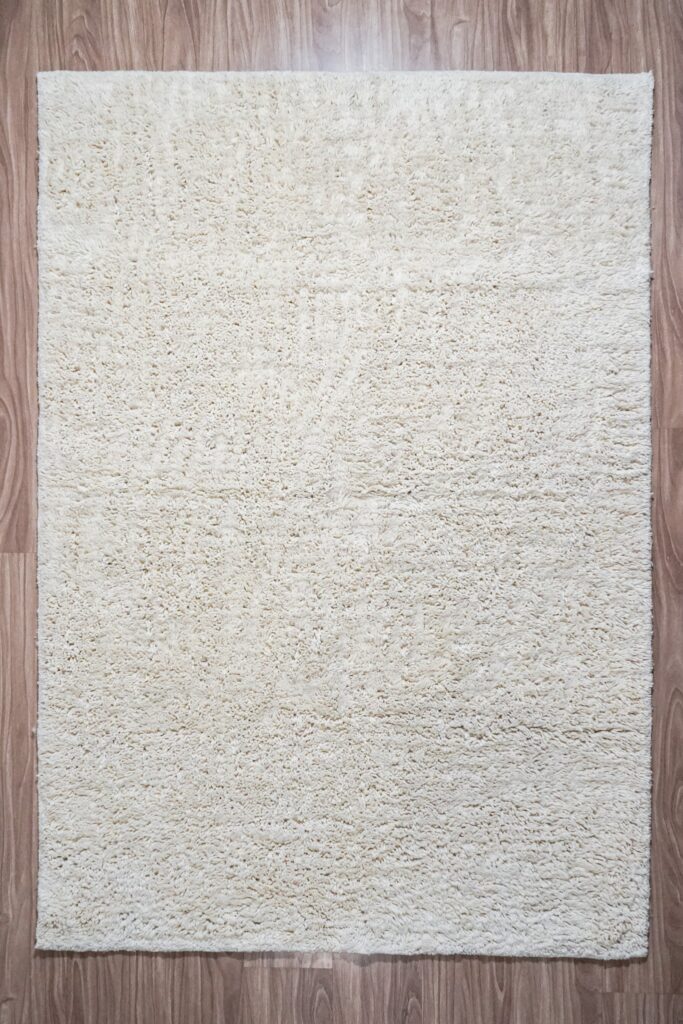
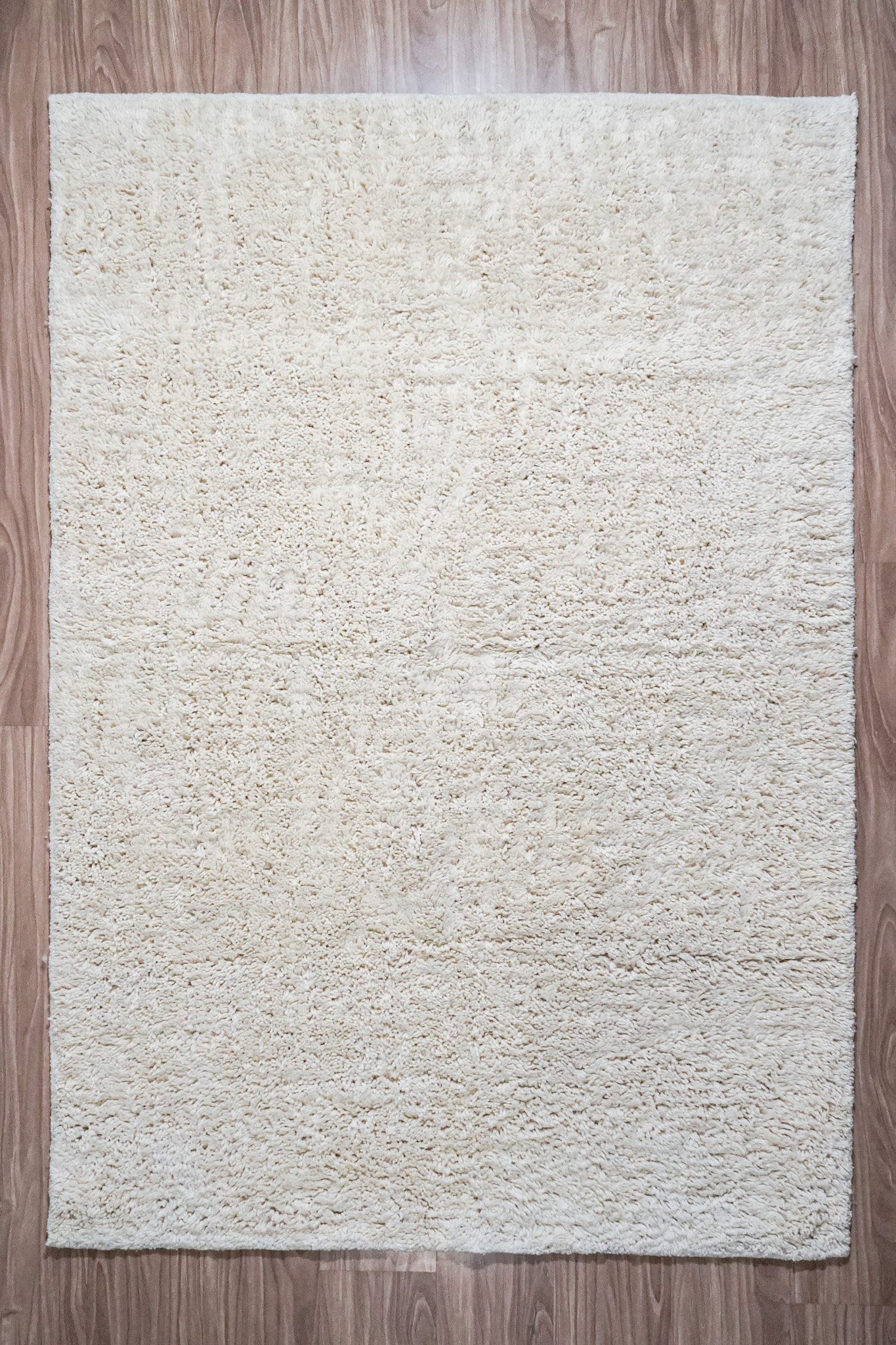
The AWD2414 series is a 100% wool handwoven shaggy with 40-45mm pile height, primary jute backing, and a knotted-fringe finish. Pile density sits at 85,000-95,000 knots per square metre, which delivers the visual softness buyers expect from a Moroccan-inspired rug while keeping the per-square-metre cost in the range that specialty retailers can retail at £180-240 for a 160×230cm piece.
Colourway strategy for 2026 wholesale orders has shifted hard toward warm neutrals with organic variation—oatmeal with flecks of charcoal, sand with irregular darker streaks, ivory that reads slightly grey in natural light. Solid whites are down 22% year-on-year in our order book; buyers cite customer resistance to high-maintenance flooring. The variation comes from blending two or three natural wool shades in the warp before dyeing, which also masks minor dye-lot shifts between production runs—a significant advantage when a retailer reorders 18 months later and expects a visual match.
Hospitality use cases are primarily boutique hotel lobbies, co-working lounge areas, and residential-style senior-living common rooms. The 40-45mm pile is too high for heavy-traffic hotel corridors (those specs usually cap at 25mm), but it works in zones where the brief calls for “residential warmth with commercial cleanability.” We’ve shipped this construction to hotel groups in the UK, UAE, and Australia; the spec that repeats is 200×290cm in a custom colourway, minimum 15 pieces per colour, with latex backing added for underlay adhesion.
MOQ for stock colourways is typically 40 pieces per size-colour combination; custom colourways start at 100 pieces total across up to three sizes. Sampling runs 12-15 days from approved Pantone or physical swatch; production lead time is 8-10 weeks FOB India once the sample is signed off.
Product 2: Hand-Tufted Geometric Wool Carpets (ATF2575) — tribal patterns for eclectic retail buyers
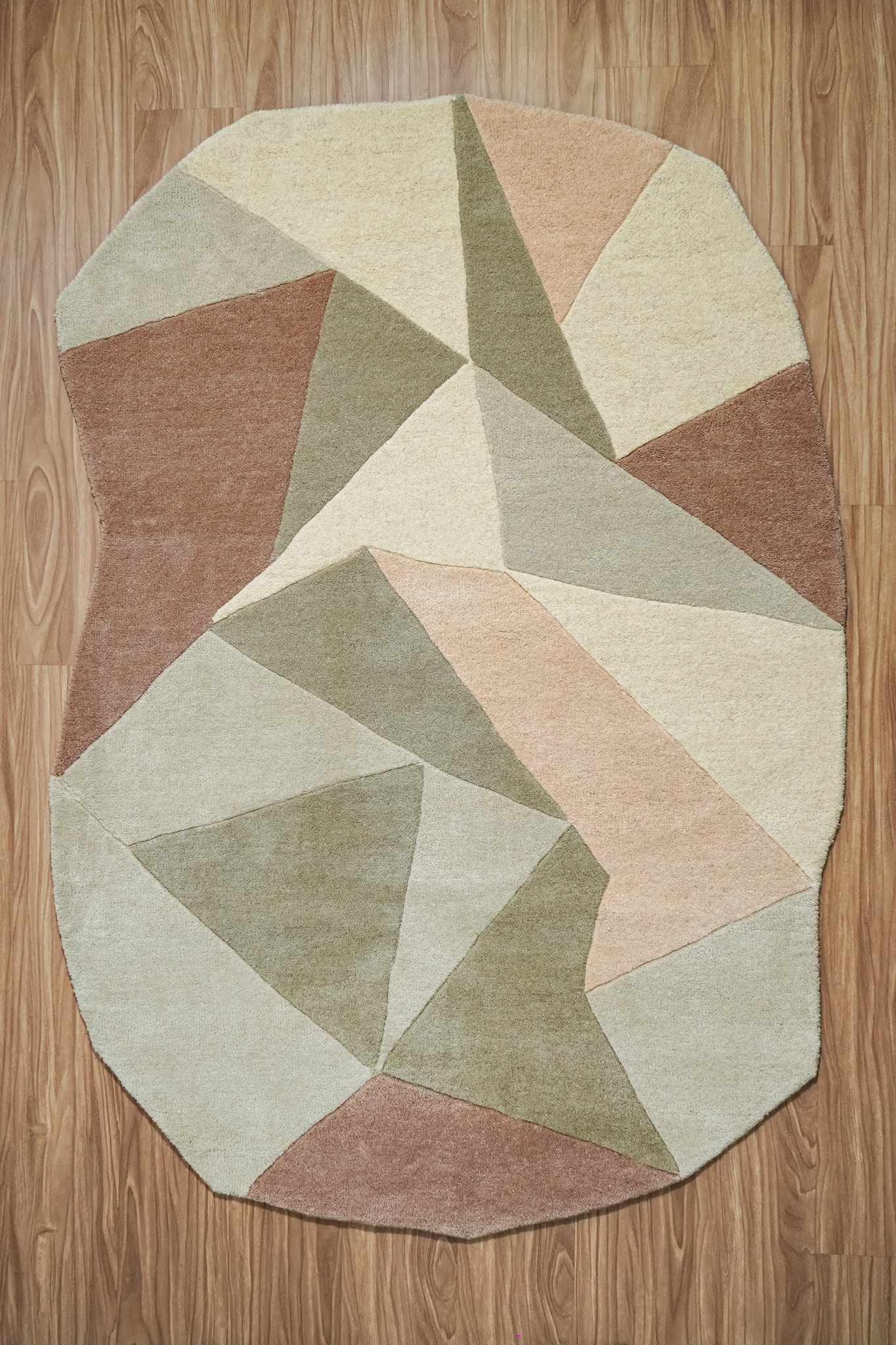
The ATF2575 range is a hand-tufted 100% New Zealand wool construction with tribal geometric patterns—chevrons, diamonds, staggered triangles—in two- and three-colour combinations. Pile height is 12mm, backing is jute primary with cotton secondary, and the edge finish is cotton-serged (not fringed), which appeals to contemporary retail buyers who want pattern without traditional rug signifiers.
Hand-tufting allows tighter pattern registration than handweaving at this price point, and it halves the lead time: 5-6 weeks production versus 10-12 for an equivalent handwoven. That speed matters for retailers working on compressed seasonal windows. A UK furniture chain ordered 320 pieces of ATF2575 in September 2024 for a January 2025 floor-set; the production cycle fit inside their 11-week purchase-to-dock window, which a handwoven program would not have.
Pattern complexity on this series maxes out at three colours because more than three introduces dye-lot coordination risk that extends sampling time and increases the reject rate at final QC. Eclectic-style retailers—think independents, design-district showrooms, online-first brands with a “global artisan” positioning—are the primary buyers. The two-colour version (usually charcoal + ivory or rust + natural) accounts for 60% of orders; three-colour (adding a third accent like teal or mustard) is the remaining 40%, almost always in custom colourways.
| Construction | Pile height | Backing | MOQ (std colours) | Lead time | |——————|—————–|————-|————————|—————| | Hand-tufted | 12mm | Jute + cotton | 50 pcs per size-colour | 5-6 weeks | | Handwoven | 8-10mm | Jute | 80 pcs per size-colour | 10-12 weeks |
Minimum order is 50 pieces per size-colour for stock patterns, 120 pieces for a fully custom design. Retailers typically order across two sizes (160×230cm and 200×290cm) in two colourways, so a 200-240 piece program. Sampling is 10 days for stock-pattern recolours, 18-21 days if the pattern itself is being customized.
Product 3: Modern Wave Hand-Tufted Oval Wool Rug (ACD2556) — differentiated shapes for design-forward retailers
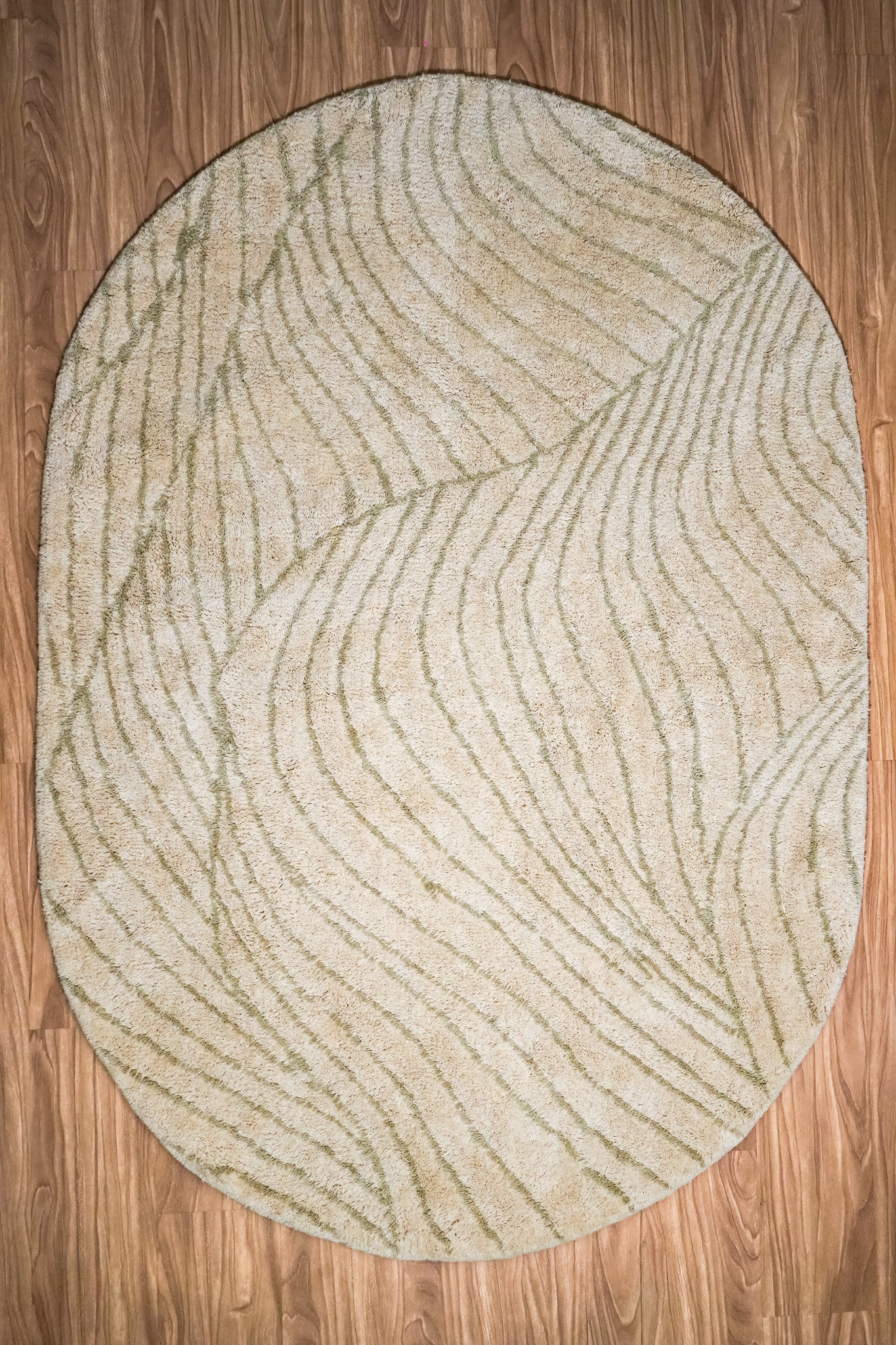
The ACD2556 is an oval hand-tufted wool rug with a tonal wave pattern—two shades of the same colour family creating subtle movement across the field. It’s 100% carded wool, 10mm pile, jute-backed, available in 120×180cm, 150×210cm, and 180×240cm ovals. Oval rugs represent less than 8% of the overall wholesale rug market, which is exactly why design-forward retailers order them: they differentiate the assortment on the showroom floor and photograph distinctively in digital marketing.
The risk with ovals is waste. Rectangular looms run more efficiently; cutting an oval from a rectangular tufted base generates 18-22% material waste, which shows up in the FOB price. Buyers need to retail ovals at a 10-15% premium versus rectangular equivalents to preserve margin, and that only works if the merchandising story supports it. Retailers who succeed with this shape tend to position it as a “signature piece” or “designer edit” rather than mixing it into the general rug assortment at the same price architecture.
Wave patterns work because they add visual interest without reading as “loud” the way geometric or floral patterns can. The tonal approach—grey and charcoal, sand and taupe, ivory and cream—allows the rug to sit in minimalist or Scandi-leaning interiors where a high-contrast pattern would compete with other furnishings. We’ve seen this construction specified for boutique retail concepts, design-hotel guest rooms (the oval softens the rectilinear furniture layout), and high-end residential projects where the designer wants a custom look without full custom pricing.
MOQ is 60 pieces per size-colour combination; custom colourways require 100 pieces minimum. Sampling runs 14-16 days because the oval shaping has to be hand-cut and edge-finished after tufting, and that process requires a full-size sample to validate. Production lead time is 7-9 weeks FOB India.
Product 4: Solid Textured Handwoven Wool Rug (AWD2569) — the versatile neutral base every collection needs
Every wholesale rug assortment needs a solid neutral that works as a base layer—under a dining table, in a bedroom, anchoring a sofa in a showroom vignette. The AWD2569 series is that rug: 100% handwoven wool in solid colours with a low-loop texture (6-8mm pile height), jute backing, cotton-serged edges. It’s the construction that doesn’t win design awards but consistently turns at retail because it solves the “I just need a good rug” customer.
Texture is critical here. A completely flat solid reads as commercial carpet; a high-shag solid shows every footprint and vacuum line. The 6-8mm low loop delivers enough surface variation to hide minor soiling and add tactile interest without drawing attention to itself. The handwoven construction (as opposed to hand-tufted) means no backing delamination risk, which matters for retail buyers who’ve dealt with customer returns on tufted solids where the backing separates after 18 months of use.
Colourways in demand for 2026: warm grey (not cool grey—that trend died in 2023), oatmeal, sand, charcoal, and a colour we’re calling “greige” that sits exactly between grey and beige depending on the lighting. Jewel tones and saturated colours have dropped to under 12% of orders for this construction; buyers want neutrals that coordinate with multiple furniture finishes and don’t limit sell-through by being too specific.
Retail use case is broad: furniture stores bundling rugs with dining sets, interior designers specifying for residential projects where the rug needs to recede, hospitality buyers ordering for guest rooms where the rug needs to be durable and easy to clean but still feel residential. MOQ is 50 pieces per size-colour; lead time is 7-8 weeks FOB India. This is also the construction that works well for private-label programs—several retail chains order it unbranded in custom sizes and attach their own labels.
Product 5: Check Pattern Handwoven Wool Rug (AWD2583) — geometrics meeting Scandinavian minimalism
The AWD2583 is a handwoven wool check—think large-scale grid, 12-15cm squares, in two-colour combinations like charcoal-and-ivory, navy-and-natural, or black-and-cream. Pile height is 8mm, construction is flatweave (no pile), backing is jute, and the edges are fringed. It’s the rug for buyers who want geometric pattern but need it to read calm rather than busy, and for retailers targeting the Scandi-minimalist customer who wants pattern without maximalism.
Flatweave construction keeps the per-square-metre cost 25-30% lower than an equivalent pile rug, which gives retailers margin room to hit aggressive price points—this is one of the few 100% wool rugs that can retail under £150 for a 160×230cm in some markets. The trade-off is underfoot softness; flatweaves work in dining areas, entryways, and layered under furniture, but they don’t work as the primary rug in a bedroom or lounge where customers expect plush.
Check patterns scale well across sizes. A 15cm grid looks balanced in a 140×200cm rug and still reads clearly in a 200×290cm, whereas many geometric patterns lose coherence or look too dense when sized up. That scalability matters for retailers who want to offer three sizes of the same design without custom artwork for each size.
MOQ is 60 pieces per size-colour; custom check sizes (e.g., 10cm grid instead of 15cm, or a three-colour check) start at 120 pieces. Sampling is 10-12 days; production is 8-9 weeks FOB India. Retailers buying this construction typically order two colourways (one high-contrast like black-and-cream, one low-contrast like grey-and-natural) across two sizes, so a 120-240 piece initial program.
If you’re building a wool rug assortment for 2026 and need construction details, colourway options, or a sample plan that covers multiple weave types, email your size-and-quantity brief to our merchandising team—we’ll come back with FOB pricing and a timeline within 48 hours.
Frequently Asked Questions
What is the minimum order quantity for wholesale wool rugs from India?
MOQ varies by construction: hand-tufted wool rugs typically start at 50 pieces per size-colour combination, handwoven ranges from 40-80 pieces depending on pattern complexity, and custom colourways or fully bespoke designs usually require 100-120 pieces minimum. Many Indian manufacturers, including our workshop, allow mixed-size orders within a single colourway to reach the minimum threshold—for example, 30 pieces in 160×230cm and 20 pieces in 200×290cm to meet a 50-piece MOQ.
How long does sampling take for custom wool rug orders?
Standard recolours of existing patterns run 10-14 days from approved Pantone reference or physical swatch. Fully custom designs—new pattern, bespoke dimensions, or novel construction—typically require 18-21 days because the sample includes artwork translation, loom setup, and dye-lot matching. Oval or non-rectangular shapes add 2-4 days for hand-cutting and edge finishing. Always request a full-size sample for custom programs; benchtop strike-offs don’t reveal backing adhesion, fringe quality, or how the pattern reads at scale.
What’s the difference between hand-tufted and handwoven wool rugs for retail buyers?
Hand-tufted rugs use a pneumatic tool to punch yarn through a fabric base, then apply a secondary backing—faster production (5-7 weeks versus 10-12), better for complex multi-colour patterns, and 20-30% lower FOB cost. Handwoven rugs are made entirely on a loom with no backing applied, making them more durable and eliminating delamination risk, but they take longer and cost more. For high-traffic hospitality or retail showroom floors, handwoven performs better; for residential collections where speed-to-market and price matter, hand-tufted is usually the right call.
Can I order wool rugs in custom sizes for a hotel project?
Yes—hospitality projects routinely specify non-standard dimensions to fit room layouts or design intent. Custom sizing adds 10-15% to the base FOB cost for hand-tufted constructions and 15-20% for handwoven, due to loom reconfiguration and increased material waste. MOQ for custom sizes is typically 80-120 pieces total across all sizes in the program. Lead time extends by 1-2 weeks versus stock sizes. At our tufting and weaving units we’ve produced everything from 90×180cm runners for hotel corridors to 300×400cm statement pieces for lobby areas—feasibility depends on loom width and shipping constraints, so share your size requirements early in the RFP process.
How do I ensure colour consistency across multiple wool rug shipments?
Specify dye-lot tolerance in your purchase order—±5% is standard for natural-dyed wool, ±2-3% is achievable with synthetic acid dyes and tight QC. Request that your manufacturer retain a physical sample from each production run and conduct a side-by-side comparison before shipping subsequent orders. UV testing is critical: wool rugs that match perfectly under warehouse fluorescent lighting can show visible variance under natural daylight or halogen retail spotlights. We run a 72-hour simulated UV cycle on first articles for exactly this reason, and we archive yarn from every dye batch for 24 months to enable reorders with minimal drift.
Enquire about your collection or project
Tell us which products you need, your preferred sizes, quantities and destination. You can also share your collection or project requirements.
Make it part of your
next collection.
Share the designs you like, approximate quantities and destination. Let’s discuss samples, pricing and custom options.

Comments (2)
Comments are closed.